

Here for support
Infidelity changes the relationship. Repairing trust changes it again.
Infidelity is rarely as simple as someone cheated because something was missing in their marriage. And understanding why an affair happened is not the same thing as excusing it.
I approach infidelity as both a betrayal or rejection injury and something that happened within a larger human system. There is the affair itself—and then there are the attachment patterns between both of you, sexual dynamics, individual histories, avoidance, unspoken needs, beliefs, and choices that each of you make.
Understanding that system you both had built, prior to the infidelity, helps us answer a question couples often ask: How did we get here?
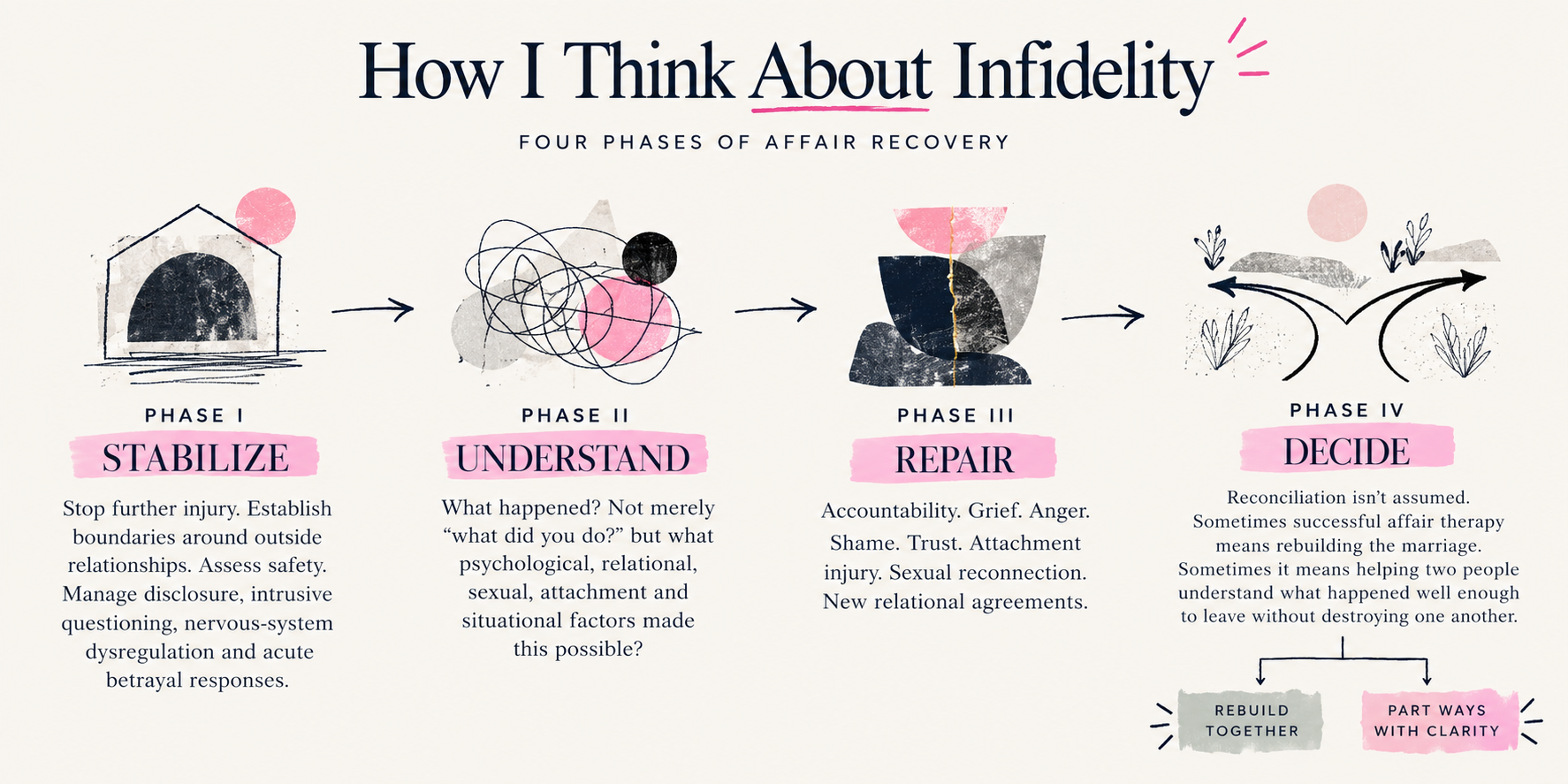
Repair begins differently.
We slow things down, establish safety, make room for anger and grief, work with the nervous system, determine what information needs to be known, and help both partners survive conversations that can otherwise become destructive.
Therapy after infidelity is less about returning to the relationship you had and more about deciding what kind of relationship you both want to build from here.
In my work with couples, I use attachment-based therapy, sex therapy, and trauma training alongside practical tools. These tools are either borrowed from multiple experts in this field after proving they are highly effective or I have created the tool over time due to my own learning of what works for couples healing from serious breaks in trust.
Some of these tools live below as free resources I offer.
Common Questions after Infidelity
-
People cheat for different reasons, and not all affairs mean the same thing. Some people seek attention, excitement, sexual novelty, or an escape from responsibilities. Others struggle with boundaries, resentment, loneliness, or the ability to tolerate uncomfortable feelings. Sometimes the affair has very little to do with the relationship itself. Understanding why someone cheated requires examining what they wanted, what they were avoiding, and how they gave themselves permission to cross a boundary. An explanation is not an excuse, but without one, meaningful change is difficult.
-
Timing and opportunity matter more than people realize. An affair may begin during a career transition, period of dissatisfaction due to conflict avoidance, birth of a new baby, or even a marriage that would be nearly perfect without the infidelity.
The outside person may offer something specific: admiration or validation, novelty, or a version of oneself that feels different from everyday life.
Sometimes that person was simply available when your partner’s emotions needed an outlet.
The important question isn't whether the affair partner was somehow better. It's what made this particular relationship appealing, and why the person who cheated chose to act on that attraction.
-
Trickle truth is when someone reveals information about an affair gradually rather than telling the full truth at once.
They may admit to texting, then kissing, then sex, often only after their partner discovers additional evidence.
Sometimes this happens because of shame, fear, or an attempt to control the consequences of you finding out.
Whatever the reason, each new revelation can feel like another betrayal. It becomes difficult to rebuild trust when the betrayed partner cannot know whether today's version of events will still be true tomorrow.
-
Because discovering an affair means realizing that part of your life was happening without your knowledge.
Your mind wants to reconstruct what happened, identify what you missed, and determine whether you're safe trusting your partner again.
Questions about dates, locations, conversations, and sexual contact can help restore an accurate understanding of events.
But some details, particularly graphic sexual comparisons, may create painful images without providing useful answers. The goal isn't to stop asking questions. It's to distinguish information that helps you understand reality from information that may leave you feeling worse.
-
Disclosure is useful when it establishes what happened, corrects false information, addresses health or safety concerns, and helps the betrayed partner make informed decisions.
It becomes destabilizing when information is repeatedly withheld, changed, or delivered during heated arguments. Graphic details can also create distress without improving understanding.
Ideally, disclosure is honest, organized, and appropriately paced, sometimes with a therapist's guidance. The goal is not to protect the person who cheated from consequences. It's to make sure the betrayed partner receives accurate information without unnecessary additional harm.
-
Sex can change dramatically after an affair. And sometimes it stays the same.
Many couples never stopped having sex even when the affair was active and continue to have sex after discovery.
Other couples stop having sex entirely.
Others experience an unexpected increase in sexual communication and actually bond over sharing their difficult opinions about their sexual life.
A betrayed partner might crave closeness one moment and feel repulsed the next.
The person who cheated may experience guilt, shame, performance difficulties, or confusion about desire.
None of these responses automatically indicates whether the relationship will survive.
Sex should not become proof of forgiveness, commitment, or recovery.
Rebuilding sexual intimacy requires understanding what each person is experiencing. It’s important not to rush to restore what either of you feel was missing. This takes time and trust.
-
OCSB stands for Out-of-Control Sexual Behavior.
An affair may be part of OCSB when someone repeatedly struggles to control sexual behavior despite genuine attempts to stop and significant negative consequences.
This might involve multiple affairs, compulsive sexual encounters, or other recurring patterns.
But cheating alone does not establish OCSB.
Some affairs involve deliberate choices, emotional attachments, poor boundaries, or dissatisfaction rather than impaired control.
Distinguishing these patterns matters because treatment differs.
Neither OCSB nor any other explanation removes responsibility for deception or harm.
-
Reconciliation should not be the goal when staying together requires someone to tolerate ongoing deception, abuse, intimidation, or repeated violations of agreed boundaries.
It is also difficult to rebuild a relationship when the person who cheated refuses accountability or continues the outside relationship against the couple's agreements.
Sometimes both partners genuinely try, yet discover they no longer want the same future.
Ending a relationship does not necessarily mean therapy failed.
Successful infidelity work can also mean understanding what happened, making informed decisions, and separating without causing unnecessary additional harm.
-
Couples Therapy after Infidelity is generally appropriate when both partners are willing to explore repairing the relationship, even if they're angry, frightened, or uncertain about the outcome.
The work focuses on understanding the affair, rebuilding trust, and determining what needs to change.
Discernment Counseling is designed for couples who disagree about whether to continue the relationship.
One partner may want to repair things while the other is seriously considering leaving.
Rather than beginning reconciliation immediately, discernment counseling helps both people decide whether to pursue repair, separate, or maintain the current situation temporarily.

The First 30-Days: A Post-Discovery Field Guide
-
A 2-page, visually guided resource to help couples reeling after discovery.
Use it to organize your thoughts, identify important questions, and clarify the decisions and patterns that need to change if moving forward together.